
Related service at Sleep and Lung Care: Allergic rhinitis care
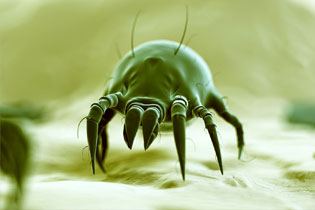
Dust mites are microscopic creatures that colonise bedding, sofas, carpets, or any woven material. Dust mites do not bite, and aside from causing allergic disease, they are not known to pose other harm to humans. Neither dust mites nor their debris can be seen under normal circumstances.
Dust mites absorb humidity from the atmosphere and feed on organic matter (including shed human and animal skin particles). They require nests to live in, a source of food and sufficient humidity.
Air filtration plays a very small role in controlling exposure to dust mites. Instead, exposure is believed to occur primarily by close proximity to dust mite debris during time spent in bed, on the floor, or on upholstered furniture.
Dust mite avoidance has been shown both to decrease symptoms and to decrease acute episodes of asthma that require treatment in a hospital in people who are allergic to dust mites.
Tips for avoiding dust mites in your home
First: Bedroom- Cover your pillows and mattresses with special zippered covers that keep dust mites away from you.
- Every week, wash your sheets, pillowcases, and blankets in hot water with detergent or dry them in an electric dryer on the hot setting. If possible, do not use a doona. Instead, use a blanket that can be washed.
- Use washable, vinyl, or roll-type window covers.
- Remove clutter, stuffed animals and other soft toys, and fabric-covered furniture. If you cannot take the stuffed animals out of the bedroom, wash them every week.
- If possible, remove carpets. Instead, use area rugs that can be cleaned or washed.
- Try to reduce the amount of fabric-covered furniture you have, especially old sofas.
- If possible, replace carpets with non-carpet flooring. This includes carpets on concrete slabs or over poorly ventilated crawl spaces.
- Every week, vacuum the house with a vacuum that has a “HEPA filter.” For cleaning floors, use a mop rather than a broom.
- Use washable, vinyl, or roll-type window covers.
- Make sure that the humidity in the home is less than 50%. Do not use a humidifier.
- People with allergies and asthma do not usually need to move, except if they live in a basement or in a home that is very damp and wet.
- If you are allergic to dust mites or mould, you might have fewer symptoms if you move to:
- An apartment on or above the second floor.
- A home with wooden floors and bedrooms on the second floor.
Insecticides and allergen-denaturing agents
The use of chemicals to kill dust mites or denature allergens was shown not to be extremely effective. Prolonged eradication of dust mites is not possible with commercially available chemicals.Dust mite desensitisation:
The house dust mite tablet contains 12 SQ-HDM (a standardised unit of house dust mite allergen potency) and is indicated for house dust mite allergic rhinitis not adequately controlled by symptom-relieving medicines in adults and adolescents aged 12 years and over. It is also indicated for adults with house dust mite allergic asthma not adequately controlled by inhaled corticosteroids and associated house dust mite allergic rhinitis. House dust mite allergy should be confirmed by a positive skin or blood test. Place the tablet under the tongue and allow it to dissolve; avoid swallowing for approximately one minute and food or drink for the following five minutes. The first dose should be taken under medical supervision with 30 minutes of observation for allergic reactions. The prescriber must check the current Australian contraindications and precautions, including lung function, recent severe asthma attacks, immune disorders, active cancer, severe inflammation or wounds in the mouth and allergy to the tablet ingredients. Common adverse effects include irritation in the mouth, ears and throat.Frequently asked questions
Is there a treatment for dust mite allergy?
Yes. Alongside avoidance measures, sublingual desensitisation tablets can treat house dust mite allergic rhinitis in eligible adults and adolescents aged 12 years and over when symptom-relieving medicines do not adequately control symptoms and allergy is confirmed by skin or blood testing.
